

Designing for Tomorrow Live
Training
Calgary, November 4, 2026


In 2026 we’re pleased to offer three half-day training opportunities
Introduction to Challenges and Opportunities in Stormwater Quality Management
Carrying LID from Planning Intent to Implementation
Stormwater Pollution Prevention for Urban Construction
Each session provides 3 instructional hours from leading local experts. Scroll down for all the details.
Introduction to Challenges and Opportunities in Stormwater Quality Management
Audience
developers and consultants
regulators
municipal staff - from planning to operations
watershed practitioners
What you will learn
Different types and sources of contaminants
Fundamentals of stormwater treatment
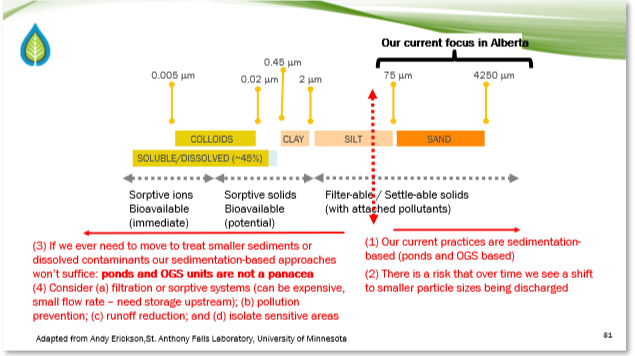
Limitations of current approaches aimed at large sediments
Practices to address finer sediments, dissolved contaminants and pathogens
How to take into account public safety, public health, source water protection needs and operational concerns
Role of low impact development
Stormwater quality management needs in Alberta are evolving.
For the past 25 years, the province’s approach has focused on removing large sediments, using them as a proxy for many other contaminants and applying this approach primarily to greenfield development. What are the limitations of this approach? How can future regulatory, operational, and community expectations be met?
This introductory course will provide a practical and accessible look at today’s stormwater quality challenges and opportunities. Participants will explore how traditional infrastructure — such as wet ponds, stormwater wetlands, and oil-grit separators — have been used to manage large sediments, while also gaining insight into the limitations of these systems when it comes to finer sediments, dissolved contaminants, and pathogens.
Contaminant types and sources will be identified, and participants will understand how low impact development can play a valuable role in addressing emerging water quality concerns.
Participants will leave with a stronger understanding of the evolving expectations facing public and private operators of urban drainage systems. Operators are increasingly being asked to consider source water protection, odours and aesthetics, public and staff safety in the presence of algal blooms, asset performance, operational resilience, and spill capture.
By connecting Alberta’s current practices with approaches from other jurisdictions, this course will give participants a broader perspective on treatment opportunities and practical pathways forward.
Your instructors

Anton Skorobogatov, M.E.Des., PhD
Anton is an interdisciplinary professional with extensive expertise in biochemistry, environmental design, and civil/environmental engineering. He is a green infrastructure specialist with more than a decade of experience in planning, design, and performance assessment of stormwater infrastructure with a focus on plant-soil interactions, low impact development and nature-based solutions.
His background spans consulting and research across bioretention systems, constructed wetlands, and integrated stormwater management strategies tailored to prairie and Alberta contexts. His work includes leading research and monitoring efforts to evaluate the effectiveness of LID systems, supporting development of Best Practices, and informing policies and standards that integrate technical rigour with environmental objectives. Anton is currently leading the update of Chapter 7 “Water Quality” of Calgary’s 2011 Stormwater Management & Design Manual.
Anton holds a Master of Environmental Design and a PhD in Engineering. He is the Vice President of the ALIDP.

Karin Björklund, M.Sc., PhD
Karin has over 15 years of experience in stormwater management and water quality research with a focus on monitoring, pollution transport, and control. She has planned and performed over 20 monitoring programs of water and soil/ sediment.
Recently, she developed a water and sediment monitoring program for the Shepard Wetland in Calgary that was tailored to meet the City of Calgary’s objectives and budget. Karin is involved in many research-related projects and has been part of literature reviews performed for the City of Calgary’s ESC program on P-values and sedimentation ponds and for the City of Vancouver on risks of stormwater infiltration to drinking water. She is currently co-leading a project on emerging contaminants of concern (e.g., microplastics, metals and organic pollutants) in stormwater.
Her other consulting experience includes projects related to the planning of stormwater management including Green Stormwater Infrastructure, Integrated Stormwater Management Plans (a B.C. planning document), and policy development for stormwater.
Karin holds an M.Sc. in Environmental Engineering and a PhD in Water Engineering.
Carrying LID from Planning Intent to Implementation
Audience
professional stormwater designers
planners
regulators
municipal staff - from planning to operations
urban forestry, roads and other disciplines involved in land development decisions
What you will learn
Where and how disconnects occur between planning and implementation
How to ensure that high-level planning is sufficiently representative of future implementation
Have you been frustrated by the disconnect that can occur between early high-level planning to include LID and the later stages of detailed design and implementation?
When alignment is lost, the original intent of the drainage strategy can be diluted or overlooked. In some cases, this may even result in urban drainage systems that no longer fully align with the assumptions, commitments, or requirements reflected in the original approvals. This session will offer practical insight into how these disconnects arise—and how they can be avoided.
Drawing on examples observed over the past two decades, the course will explore how planning, analysis, design, review, approval, and implementation can be better connected from start to finish. Participants will examine how Master Drainage Planning / Area Master Planning and Staged Master Drainage Planning / Neighbourhood Design creation, and subsequent implementation, can be aligned to ensure that high-level concepts remain realistic, defensible, and practically achievable.
The course will also provide recommendations for preserving original project intent as work moves across organizations, disciplines, and approval stages, helping both the design and review communities support more consistent, compliant, and successful stormwater outcomes.
Your instructors

Bert van Duin, M.Sc., P.Eng.
Bert has close to 40 years of experience in urban drainage, stormwater management and watershed management across Alberta, British Columbia, Saskatchewan and Ontario. Before joining The City of Calgary, he provided stormwater and watershed management services to the land development industry, municipal governments and provincial government in the Calgary area, leading multi-disciplinary teams and major studies related to drainage planning, BMPs and source control practices. He has been the Drainage Technical Lead at The City of Calgary since 2009, where he supports the practical implementation of sustainable drainage practices, updates to the Stormwater Management & Design Manual and LID Modules, staff training and mentoring, and stormwater research through the Drainage Knowledge Program.
As an Adjunct Assistant Professor at the University of Calgary and the University of Alberta, he contributes to professional education and applied research. Nationally and internationally, he has provided leadership on CSA Group stormwater and green infrastructure standards, flood resiliency initiatives, ASCE-EWRI publications, and the 2024 open-source IWA handbook on urban drainage asset management. He is a founding member and past president of the ALIDP.
Brier Reid, M.E.Des., RPP, P.Eng.
Brier is a Senior Stormwater Engineer with The City of Calgary's Environmental Risk and Resilience department. She has extensive experience in stormwater management and the practical application of Low Impact Development (LID) principles within municipal infrastructure planning and delivery. Brier has been involved in advancing sustainable watershed and drainage solutions, with a particular focus on integrating environmental, technical, and community objectives into project planning and implementation. Known for her thoughtful approach, practical problem-solving, and commitment to sustainable city-building, she has helped advance stormwater and green infrastructure initiatives from planning through to implementation.
Stormwater Pollution Prevention for Urban Construction
From Fundamentals to Field Reality
Audience
developers and consultants
contractors
Erosion and Sediment Control supervisors and inspectors
regulators
municipal staff
watershed practitioners
What you will learn
Effective Stormwater Pollution Prevention (SWPP) and Erosion and Sediment Control
Key processes that drive erosion, sediment transport and runoff
SWPP planning, source control and field implementation
How to improve coordination, respond to issues, and maintain compliance
Urban stormwater runoff can carry a wide range of pollutants—including sediment, heavy metals, hydrocarbons, road salt, and pathogens—that affect infrastructure, ecosystems, and communities. Across Canada, urban development continues to be a significant source of stormwater pollution, creating cumulative impacts that make effective prevention, planning, and field implementation more important than ever.
This half-day course will offer a practical and engaging introduction to stormwater pollution prevention (SWPP), with a focused look at erosion and sediment control (ESC) for urban construction and development. Participants will build a strong foundation in the processes that drive erosion, sediment transport, and runoff, while exploring how construction activities, site conditions, and changing weather patterns can influence stormwater quality.
Through practical examples, participants will examine common sources of stormwater pollution across construction, industrial, commercial, residential, and other urban settings, and understand how these pollutants move through municipal stormwater systems to receiving environments. The course will connect these fundamentals to effective SWPP planning, source control, and field implementation, including the role of best management practices (BMPs) and the practical limitations of relying solely on downstream controls.
The course will also tackle common implementation challenges, such as gaps between planning and field execution, unclear roles and responsibilities, and communication breakdowns across project teams. Participants will gain practical strategies for improving coordination, responding effectively to field issues, and supporting compliance, reinforced through case-based examples and applied discussion.
If you are looking to strengthen your applied ESC and stormwater pollution prevention practice—and achieve better outcomes on the ground — this course is designed for you. Whether you are new to the field or an experienced professional looking to sharpen your approach, the course is well suited for municipal staff, regulators, consultants, contractors, ESC supervisors, developers, watershed practitioners, and others involved in urban development, construction, and stormwater management.
Participants will leave with a clearer understanding of SWPP fundamentals, practical tools for implementation, and greater confidence in supporting effective, compliant, and environmentally responsible stormwater outcomes.
Your instructor

Graham Tait, CPESC, CPSWQ, CESSWI
Graham is a Stormwater Pollution Prevention Specialist with The City of Calgary, working within Water Services to protect urban water systems and receiving environments.
Currently completing a Master of Science in Environmental Practice, Graham brings over 25 years of experience in stormwater pollution prevention with subject matter expertise in project site assessment, stormwater pollution prevention plan (SWPPP) development and implementation, compliance inspections, and spill incident response.
Graham has contributed to the development and delivery of extensive education and training initiatives for organizations including The City of Calgary, the Canadian Chapter of the International Erosion Control Association, and California Stormwater Awareness Week. He also serves as an Industry Advisory Board Member for the University of Calgary’s Sustainable Systems Engineering undergraduate program and contributed to the Canadian Standards Association’s Turbidity Monitoring Standard.
Passionate about collaboration, Graham enjoys working with industry partners and mentoring the next generation of watershed planners and stormwater professionals.
Where to next?
Sponsor/ Exhibit

Registration Details

Venue
Conference